To choose a virtual assistant company, decide first which type of provider to use, then compare companies on ten criteria: price, management, fit, AI policy, data, location, terms, replacement, start time and reporting. Giving each company the same task list, asking for written answers and running a one-week test before committing keeps the comparison fair.
What does a virtual assistant company do?
A virtual assistant company supplies remote assistants who handle recurring work for you, such as inbox care, scheduling, CRM updates, lead research, social media and e-commerce tasks. The company usually finds and trains the assistant, matches them to your needs and may manage the relationship. What differs between companies is how much of that they do for you.
What types of virtual assistant provider are there?
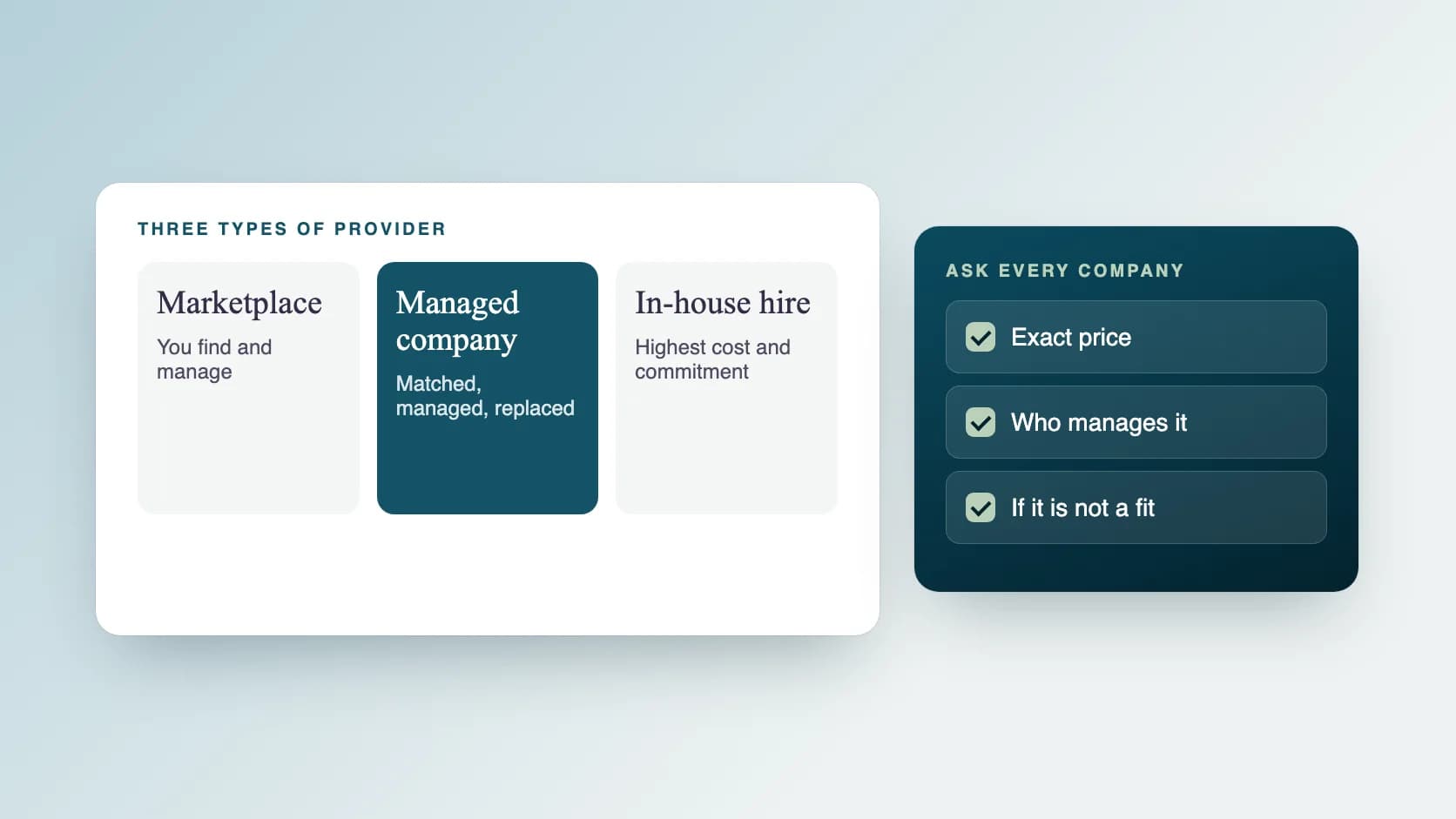
Most options fall into four groups. Each trades control against effort and risk.
- Freelance marketplaces: you find, vet and manage an individual yourself. You have the most control and the most work, and no one steps in if the person leaves.
- Managed companies: a company matches you with an assistant and manages the relationship, with updates, reporting and replacements. Ragiles works this way.
- Specialist agencies: assistants focused on one area, such as bookkeeping or e-commerce. Good when you need deep skill in one thing.
- In-house hires: an employee on your payroll. This has the highest cost and commitment, and the most control.
- AI tools alone: software you operate yourself. Fast for quick tasks, but it does not follow up or take responsibility. See AI tool or virtual assistant.
Which type fits your situation?
Use these as a starting point.
- You have time to manage and want the lowest cost: a marketplace.
- You want someone to carry the management and replace people when needed: a managed company.
- You need one specialist skill: a specialist agency.
- You have steady full-time work and want an employee: an in-house hire.
- You only need quick drafts and summaries: an AI tool.
Which ten criteria should you compare?
Use the same ten for every company on your shortlist.
- Price: the cost for your exact task list and weekly hours.
- Management: who oversees the work and what they are accountable for.
- Fit: how the provider matches an assistant to your tasks, tools and hours.
- AI policy: whether assistants use AI tools, and whether a person checks the work.
- Data and access: how personal details are protected and who can open which accounts.
- Location and time zone: where assistants are based and which hours they cover.
- Terms: the minimum term, the notice period and any set-up fee.
- Replacement: what happens if the assistant is not the right fit.
- Start time: how fast work can begin.
- Reporting: how often you get updates and what the report contains.
How do you compare prices fairly?
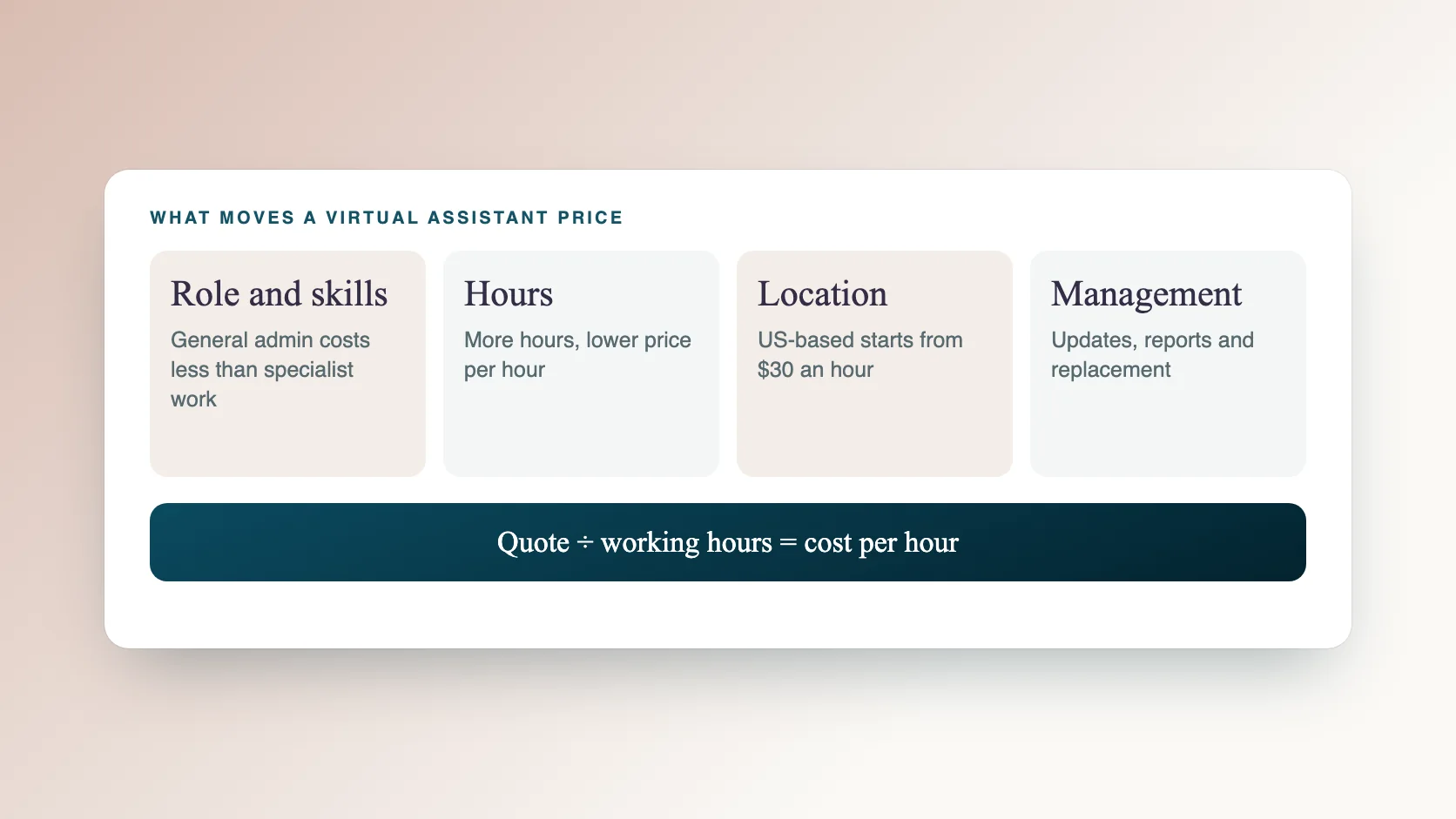
Ask each company for a written quote for the same task list and the same weekly hours. Then divide each quote by the number of working hours it covers, to get a cost per hour. A higher monthly price can be a lower hourly price. Check what is included, such as management, onboarding and reporting. Our guide on what a virtual assistant costs shows the method, and our guide on hourly, monthly and per-task pricing goes further.
Who should manage the assistant?
Ask who your point of contact is, what they are responsible for and how to reach them if something goes wrong. The best arrangements give you a named person who learns your business, runs onboarding, trains the assistant and stays accountable for the result. See how managed support compares for questions to ask.
How do you test a company before you commit?
A one-week test tells you more than a sales call.
- Pick three to five real tasks, such as sorting the inbox, updating the CRM and building a lead list.
- Write what a good result looks like for each.
- Give every shortlisted company the same tasks.
- Compare accuracy, speed, communication and how much you had to correct.
- Use our first week checklist to run it.
What should you know about AI and data?
Ask which AI tools assistants use, what information goes into them and who can see it. Ask whether a person checks every AI draft, and whether you can request an assistant who does not use AI tools. Ask how access is given and removed. Our guides on AI-augmented vs traditional assistants and keeping data safe explain the questions in detail.
Does location and time zone matter?
It can. Phone calls in US business hours are easier with a US-based assistant, while tasks that run asynchronously work well across time zones. Ask where assistants are based and what overlap you will have. Our guide on working across time zones shows how.
What contract terms should you check?
Look for the minimum term, the notice period, any onboarding or set-up fee, what happens to unused hours and how replacements work. Short, flexible terms let you leave if the fit is wrong. Long contracts signed before you have tried the support are a warning sign.
What warning signs should you watch for?
Be careful if a company:
- will not give a written quote for your task list.
- cannot say who manages the work.
- asks for a long contract before you have tried it.
- will not explain how it handles replacements.
- is vague about AI use or data.
- promises results it cannot control.
What does a copyable scorecard look like?
Score each company from 1 (poor) to 5 (excellent) on each criterion, add the totals and discuss any score of 1 or 2 before you decide.
- Price for my task list: 1 to 5.
- Management and point of contact: 1 to 5.
- Fit with my tasks and tools: 1 to 5.
- AI policy and human checking: 1 to 5.
- Data and access: 1 to 5.
- Location and time zone: 1 to 5.
- Terms and exit: 1 to 5.
- Replacement: 1 to 5.
- Start time: 1 to 5.
- Reporting: 1 to 5.
What is a simple selection process?
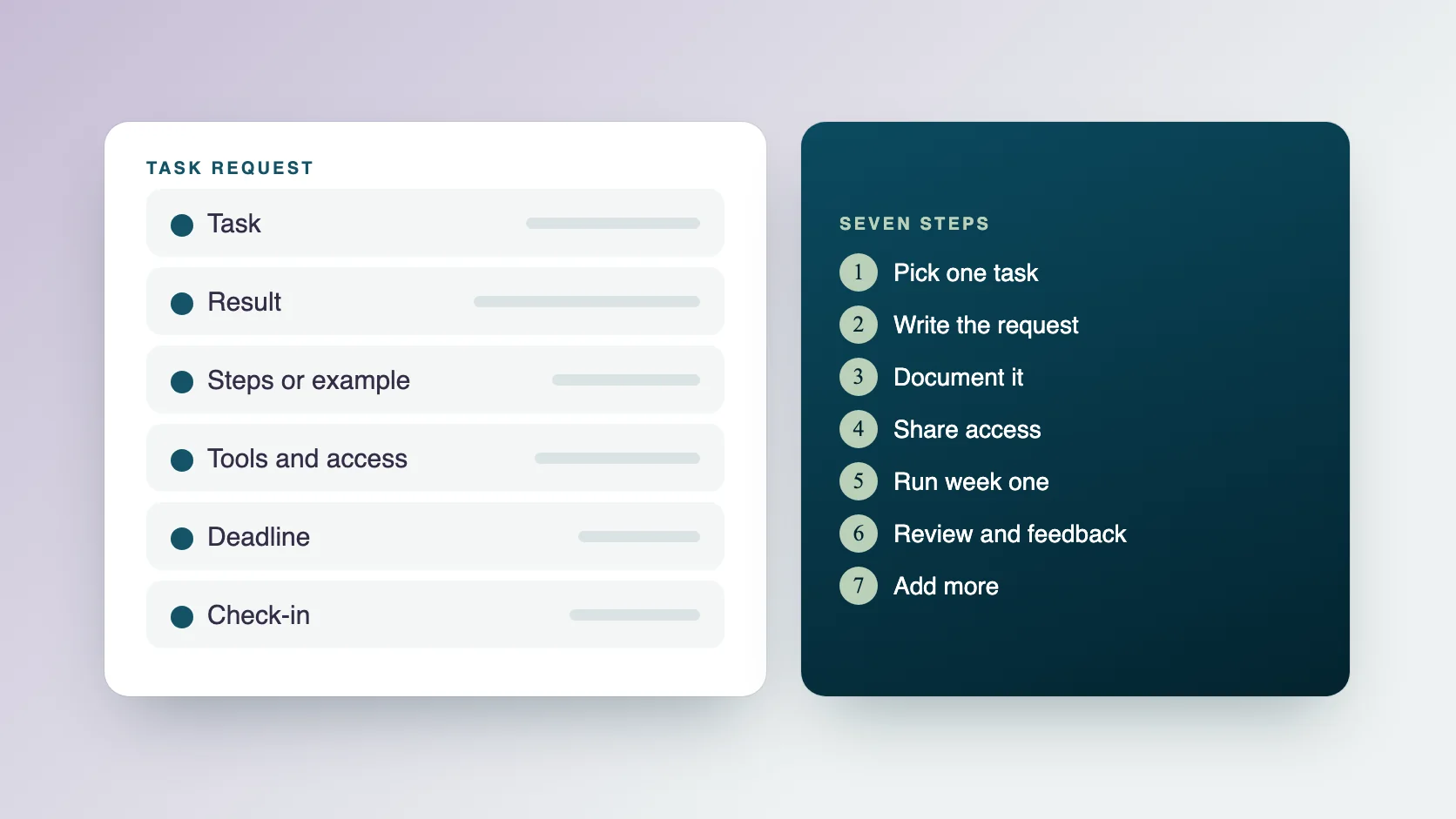
Follow these seven steps.
- Write your task list and weekly hours.
- Choose the provider type that fits.
- Shortlist three companies.
- Send each the same brief and ask the same ten questions.
- Run a one-week test with real tasks.
- Score each company and talk to your top two.
- Start with one or two tasks, and review closely.
What does Ragiles offer?
Ragiles is a managed company with assistants in India, Pakistan, the Philippines, the UAE and the US. A project manager learns your business, runs a structured onboarding, assigns the right assistant and trains them on your processes. You get a daily update on Slack or the tool you already use, a weekly report with the full week and the plan for the next one, and a meeting whenever you need one. If your assistant cannot take on a new task, we replace them with a more expert assistant for the responsibility you give. Every price is a starting price, and we quote the exact rate before you start.
- Hourly: from $5 an hour.
- Part-time: from $500 a month, for 5 hours a day.
- US-based: from $30 an hour.
- Full-time: from $800 a month.
- No onboarding fee, no long contract, month-to-month.
- Work can start within 2 days of agreeing the plan.
- AI-augmented by default, with a person checking every AI draft. A traditional assistant is available on request at the same price.
- Personal details are kept secure and used only for your work, and you choose which accounts your assistant can open.
When might Ragiles not be the right fit?
If you need a single specialist skill that we do not offer, or you want an employee on your own payroll, another type of provider may suit you better. Use the scorecard to decide, and ask us the same ten questions.
Where can you read more?
Our comparison guides apply these questions to specific providers: pricing models, a one-week task test, managed support, switching providers, sizing your hours and onboarding. We do not list other companies' prices, so check each company's own website for current details.
Common questions
How many companies should I compare? Three is enough. More makes the decision harder without improving it.
Should I choose the cheapest? Compare cost per working hour and what is included, then weigh management, replacement and fit.
Is a trial worth it? Yes. A one-week test with real tasks shows more than any sales call.
Do I need a contract? Prefer month-to-month terms until you are sure.
What if the assistant is not a good fit? Ask in advance how replacement works. At Ragiles, we replace them with a more expert assistant.
Should I ask about AI? Yes. Ask which tools are used, what data goes into them and whether a person checks the work.
Can I switch providers later? Yes. See our guide on switching without a gap.
How fast can I start? At Ragiles, work can start within 2 days.