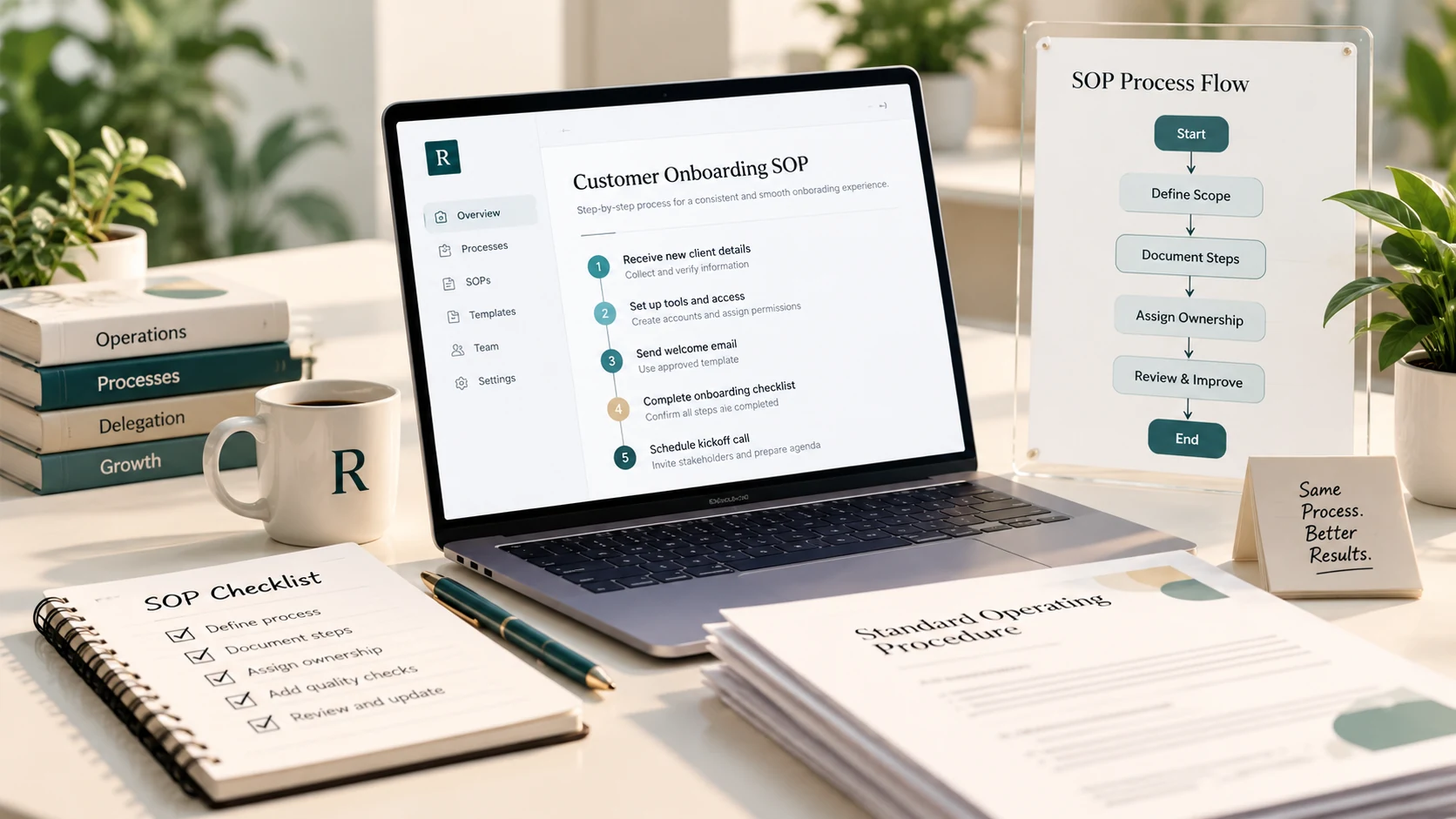
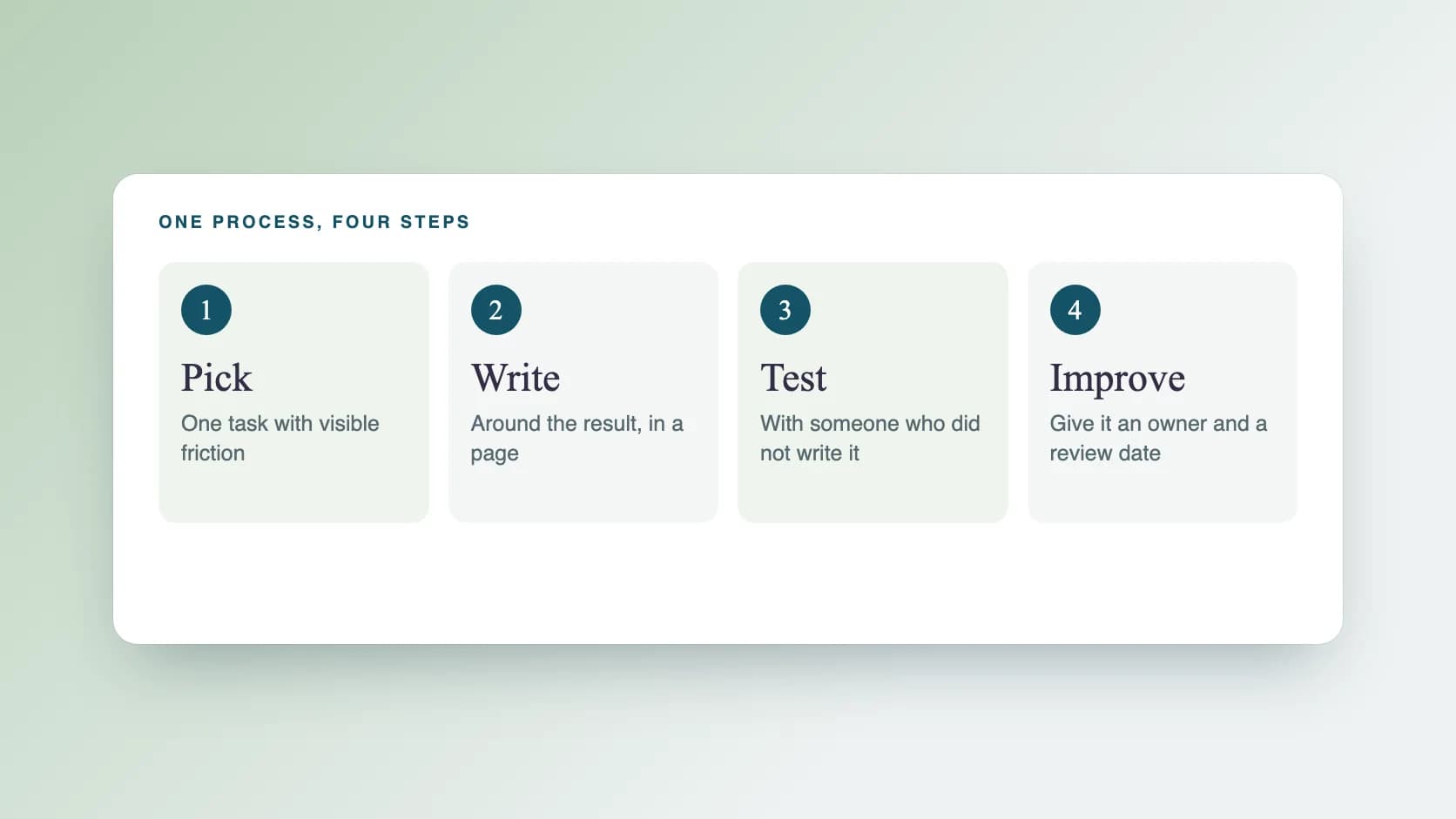
When the same task is done differently each time, people rely on memory, ask the same questions and repeat avoidable mistakes. A short, clear process fixes that without turning a business into a manual. Four steps turn recurring work into a process: pick one task, write it around the result, test it and keep it current.
Which process should you write first?
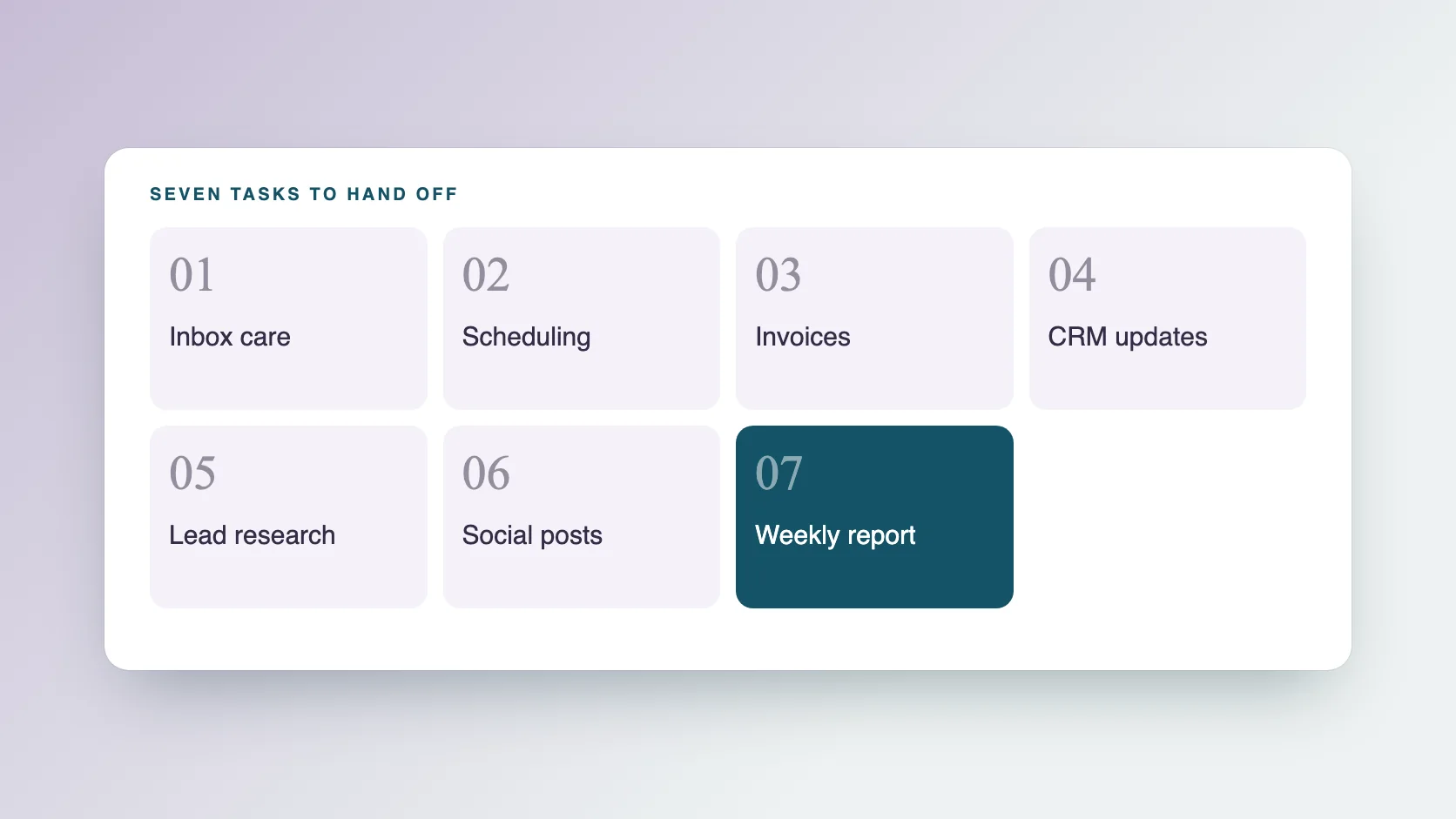
Pick one that has visible friction: it takes longer than it should, it gets handed over often, or mistakes keep happening. Good candidates are onboarding a client, sending invoices, publishing a post and preparing a weekly report. Write one process before you write ten.
How do you write a process around the result?
Start with the outcome, then the steps. A process people can follow answers six questions.
- What is the result, and who is it for?
- What triggers the task?
- What are the steps, in order?
- What tools and files are involved?
- Who owns it, and who checks it?
- What do you do when something goes wrong?
How long should a process be?
Short enough to read in two minutes. One page or a checklist is usually enough. A long document that nobody opens is worse than a short one people use. Add detail only where mistakes actually happen.
How do you test a process?
Ask someone who did not write it to follow it on a real task. Watch where they stop, ask questions or do something differently. Each of those moments shows a missing step or an unclear instruction. Fix those first.
How do you keep a process useful?
Give it an owner and a date to review it. When a tool changes or a mistake repeats, update the process the same week. A process nobody maintains turns into a trap.
Where do assistants fit in?
A written process is what makes delegation work. An assistant can follow it, tell you where it is unclear and keep it up to date. Our guide on how to write an SOP has a template you can copy. At Ragiles, a project manager helps structure the onboarding so your assistant starts with a clear plan.
Example: a six-step client onboarding process
A process this size is enough for many small teams.
- Trigger: a client signs the agreement.
- Send the welcome email using the saved template.
- Create the client folder and add the standard documents.
- Add the client to the CRM with the start date and owner.
- Book the kickoff call and send the agenda.
- Check on day three that the client has what they need, then log it.
What mistakes should you avoid?
Watch for these common problems.
- Writing a process nobody will read because it is too long.
- Describing every click instead of the result and the decisions.
- Leaving out what to do when something goes wrong.
- Writing it once and never reviewing it.
- Giving it no owner.
Common questions
What is the difference between a process and an SOP? An SOP is a written process with a standard format. A process can be a simple checklist.
Do small teams need written processes? Yes, for work that repeats or gets handed over. It saves time as soon as a second person is involved.
How many processes do I need? Start with the three tasks that waste the most time or cause the most mistakes.
Where should I store them? Somewhere everyone can find and edit, such as a shared drive or wiki, with one index page.
Where can I read more? See our guides on how to write an SOP and how to delegate to a virtual assistant.
Where can I read more? See our guides on how to write an SOP and how to delegate to a virtual assistant.